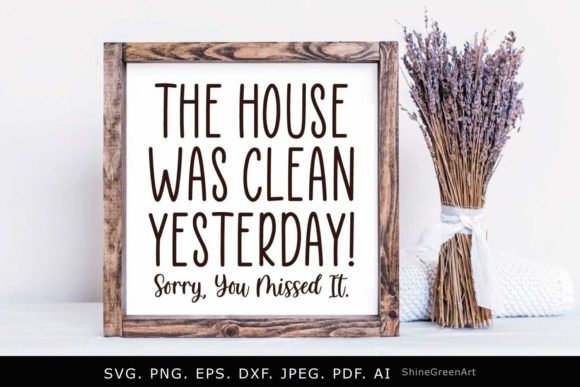
The House Was Clean Yesterday Funny Home Graphics in Crafts
As a brand designer who has spent years crafting identities for local bakeries, boutique shops, and handmade product lines, I know that the right visual asset can make or break a small business project. Recently, I evaluated The House Was Clean Yesterday Funny Home as a potential graphic design asset for a real-world branding campaign. My goal was to determine if this piece could serve as a versatile tool for packaging design, promotional materials, and social media graphics for a creative entrepreneur launching a new line of home goods.
My first impression of The House Was Clean Yesterday Funny Home is one of immediate relatability. It exudes a playful, friendly, and slightly rustic personality. In the crowded world of modern design, humor often serves as a powerful bridge between a brand and its customer. This specific design feels less like a corporate logo and more like a warm invitation into a lived-in, authentic space. It suggests a brand that does not take itself too seriously but values quality and comfort. For a local business owner running a candle shop, a soap maker, or a cozy coffee house, this asset offers a distinct mood: it is approachable, organic, and deeply human.
When we talk about small business branding, consistency is key. The House Was Clean Yesterday Funny Home fits seamlessly into a narrative that prioritizes emotional connection over sterile perfection. It works exceptionally well for businesses that want to highlight their handmade nature. Imagine this design printed on a kraft paper hang tag attached to a jar of artisanal body butter, or perhaps stamped onto a reusable tote bag sold at a weekend farmers market. The text carries a conversational tone that invites the customer to smile before they even open the package.
Integrating Humor into Professional Brand Identity
In my experience reviewing various design assets, finding the balance between fun and professional is often the hardest part of logo design. Too much whimsy can undermine trust, while too little can make a brand feel cold. The House Was Clean Yesterday Funny Home manages this balance surprisingly well. It is bold enough to be read from a distance but subtle enough to act as a decorative element rather than the sole focus of the layout.
I tested this concept with a hypothetical local bakery specializing in sourdough and pastries. Placing this graphic on a menu board or as a sticker on the bottom of a pastry box creates a memorable first impression. It signals to the customer that the owners are passionate and have a sense of humor. This kind of personality is crucial for product recognition. When a customer sees the phrase again on Instagram or Facebook, they will immediately associate it with the bakery's unique voice. It transforms a standard transaction into an interaction.
This asset also supports clearer visual hierarchy in marketing visuals. By using The House Was Clean Yesterday Funny Home as a hero graphic on a website banner or a seasonal campaign poster, you can draw the eye immediately to the message. It breaks up blocks of text and adds a layer of visual interest that keeps the viewer engaged. For social media managers looking to boost engagement, content that evokes emotion—like laughter or nostalgia—performs significantly better than generic stock imagery.
Practical Applications for Packaging and Promotional Materials
The versatility of this design makes it a powerhouse for packaging design. Whether you are creating labels for food products, stickers for craft supplies, or decals for home decor items, this asset provides a solid foundation. I specifically looked at how it would function on a product mockup for a line of homemade soaps. The design sits perfectly on a square label, allowing the brand name to sit above it and ingredients below, creating a balanced composition.
For handmade business owners, the ability to scale this graphic is essential. Because the source files include vector formats, the design retains its crisp edges whether it is printed on a large flyer or a tiny price tag. This ensures that your professional branding remains sharp across all touchpoints. You can use the transparent PNG version to overlay the text directly onto photos of your products for online listings, or use the vector file to cut out physical shapes for window displays.
Beyond packaging, this graphic is ideal for promotional ads and printable inserts. A thank-you card included with every order featuring this message can turn a satisfied customer into a loyal advocate. It adds a personal touch that mass-produced brands simply cannot replicate. Furthermore, it works beautifully as a decorative brand element in editorial design layouts, such as lookbooks or catalog pages, where it can frame product photography without overpowering it.
Strategic Placement and Design Considerations
While this asset is highly effective, a seasoned designer knows that context matters immensely. There are specific scenarios where The House Was Clean Yesterday Funny Home should be used carefully. It is generally not suitable for formal corporate branding or luxury minimalist brands that rely on understated elegance. If your target audience expects high-end sophistication, a humorous slogan might dilute the perceived value of your product.
Additionally, avoid placing this graphic in areas with heavy legal information or ingredient lists. Visual clutter can confuse the consumer and reduce the impact of important details. On very small labels, ensure there is enough negative space around the text so it remains legible. Low-contrast backgrounds can also hide the design, so always test the color pairing before finalizing your print run. For example, white text on a light beige background might disappear, whereas black text on a vibrant accent color would pop effectively.
When evaluating design assets for commercial use, I always recommend testing them against competitor packaging. Does this design stand out in your category? In the home goods sector, many brands use floral motifs or geometric patterns; a witty, text-based design like this one offers a refreshing alternative that captures attention through wit rather than just aesthetics.
Technical Notes for Implementation
From a technical standpoint, the inclusion of multiple file formats is a significant advantage for any commercial design project. Having access to SVG, EPS, AI, DXF, PNG, JPEG, and PDF files means you are prepared for any production method. If you are using a cutting machine for vinyl decals, the SVG and DXF files are indispensable. If you are working with a professional printer, the high-resolution PDF and EPS files ensure perfect output.
I strongly advise checking the transparency of the PNG file before integrating it into your workflow. A clean transparent background allows for seamless layering in software like Canva or Adobe Illustrator. When combining this graphic with typography, I suggest experimenting with different font pairings. A handwritten font next to this design enhances the rustic feel, while a clean sans-serif font creates a more modern contrast. Always preview the design in black and white to ensure the visual weight holds up without color support.
Finally, confirm your commercial license before using this asset for client work or physical product sales. Understanding the usage rights protects both you and your business. Once cleared, you can confidently deploy The House Was Clean Yesterday Funny Home across your entire brand ecosystem. From the initial product mockup to the final social media post, this graphic design asset offers a reliable way to elevate your brand identity and connect with your local community.
Ultimately, successful small business branding relies on authenticity. The House Was Clean Yesterday Funny Home delivers exactly that. It brings a human element to your products, making them feel less like commodities and more like gifts from a friend. For creative entrepreneurs looking to add personality to their crafts and graphics, this is a smart investment in their brand's future.